THE THÁI HỌC COURTYARD
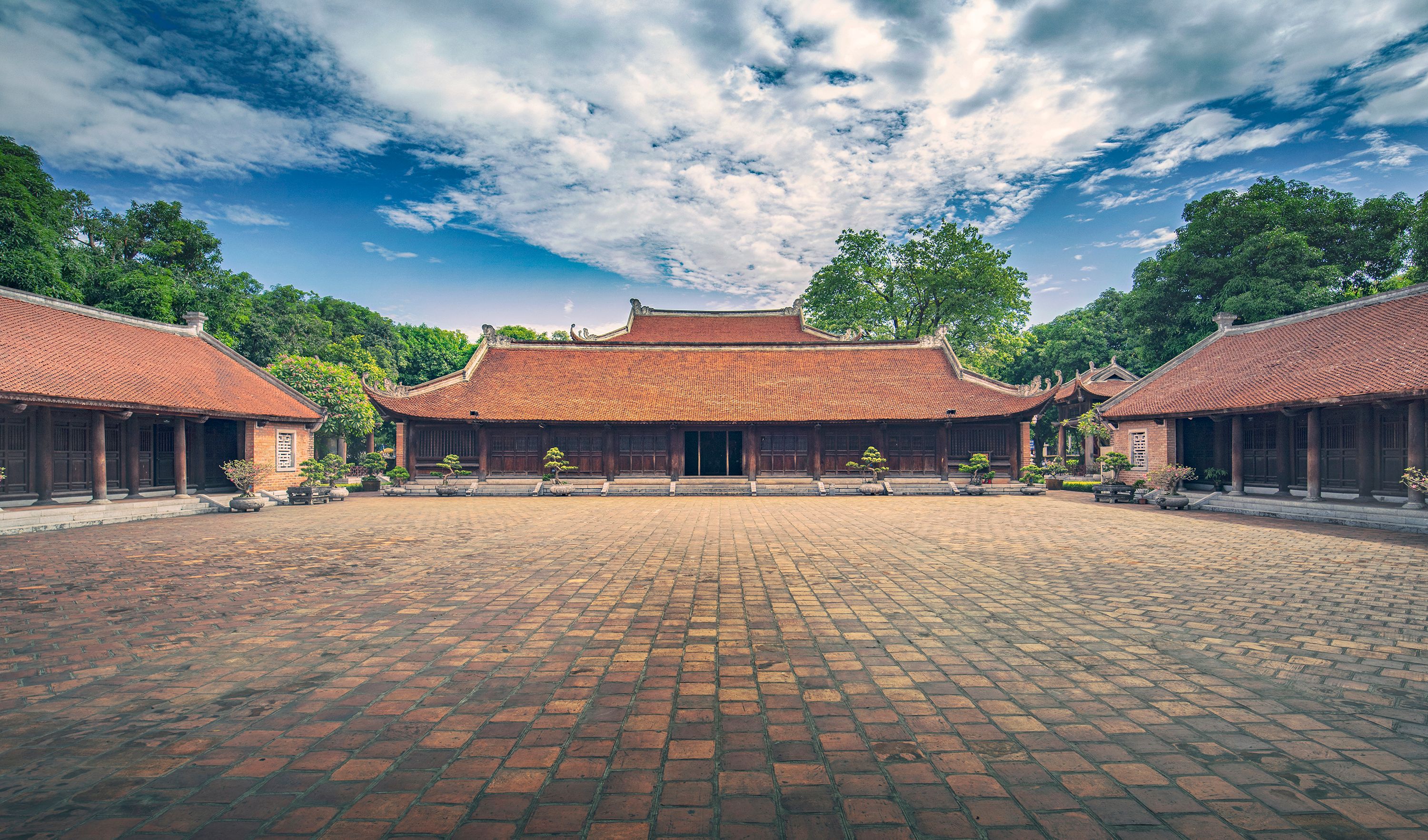
The Thái Học Courtyard was reconstructed in 2000 on the original site of the former Quốc Tử Giám, Vietnam’s first national university. The complex consists of newly built structures designed in a traditional architectural style, including the Tiền Đường (Front Hall), Hậu Đường (Rear Hall), the Eastern and Western Side Houses, the Bell Pavilion, the Drum Pavilion, and the Eastern and Western Gates.
The Tiền Đường (Front Hall) serves as a venue for commemorative ceremonies honoring distinguished scholars, scientific conferences, exhibitions, and various traditional cultural and artistic activities.
The Hậu Đường (Rear Hall) consists of two floors:
The first floor houses the statue of Chu Văn An, who served as the Tư Nghiệp (Rector) of Quốc Tử Giám. It also features an exhibition entitled “The History of Văn Miếu - Quốc Tử Giám and the Vietnamese Educational and Examination System.”
The second floor is dedicated to three emperors who played pivotal roles in the establishment and development of Văn Miếu - Quốc Tử Giám and in promoting Confucian education in Vietnam:
Lý Thánh Tông (1023–1072), founder of Văn Miếu in 1070;
Lý Nhân Tông (1066–1128), founder of Quốc Tử Giám in 1076;
Lê Thánh Tông (1442–1497), who greatly expanded the educational system and initiated the erection of the Doctors’ Stelae in 1484.
Today, the Thái Học Courtyard serves as an important cultural and educational space, honoring Vietnam’s tradition of learning, respect for teachers, and the cultivation of talent.